
How to Get Out of Debt Without Letting It Overwhelm You

Debt can weigh on nearly every part of your life.
When you're trying to keep up with the rent or mortgage, electricity, groceries, credit cards, car payments, and other bills, it can feel like your money is already spoken for before you even have a chance to decide what to do with it.
Add debt balances and interest on top of everyday household expenses, and figuring out how to get ahead can feel overwhelming.
Financial stress doesn't always stay confined to your finances, either. It can keep you awake at night, affect your mood, make it harder to concentrate, and leave you constantly thinking about the next bill or unexpected expense.
And when the numbers feel overwhelming, avoiding them can feel easier than looking.
But avoiding them also makes it difficult to know what you can actually do next.
You don't have to figure out your entire financial future at once. Getting out of debt starts with understanding where you are right now and creating a plan for moving forward from there.
Step One: Get Clear on What You Owe
The first step in a debt repayment strategy is to put all of the information in one place.
For each debt, write down:
Your current balance
Interest rate
Minimum monthly payment
Payment due date
Whether the account is current or past due
Then look at the expenses that keep your household running: housing, utilities, groceries, transportation, insurance, childcare or caregiving costs, and other necessities.
What remains after those expenses and your required minimum payments will help you understand what, if anything, you can currently put toward paying down debt faster.
And if there isn't much left, that's important information too.
The purpose of this first step isn't to judge your finances. It's to replace the vague feeling of "I have too much to pay"with a clear picture of what you're actually managing.
Once you can see the full picture, you can start deciding what to do with it.
Two common approaches are the debt snowball and debt avalanche methods.
The Debt Snowball Method: Build Momentum With Smaller Wins
With the debt snowball method, you pay your debts from the smallest balance to the largest balance, regardless of interest rate.
Continue making the minimum payment on every account. Then put whatever additional amount you've designated for debt repayment toward the account with the smallest balance.
Once that debt is paid off, take everything you were paying toward it and add it to the payment on your next-smallest debt.
Continue the process until you've worked through the list.
Why the Snowball Method Can Work
Progress can be motivating.
Paying off a smaller balance gives you a visible win and eliminates one payment from your list. For someone who has been feeling overwhelmed by the number of accounts they owe, seeing that list get shorter can make it easier to keep going.
The method is also simple. You don't need complicated calculations. Once your debts are organized by balance, you know exactly where your extra payment goes.
The Tradeoff
The smallest debt isn't necessarily the most expensive debt.
If accounts with higher interest rates remain unpaid while you tackle smaller balances, you may ultimately pay more interest than you would with another repayment strategy.
That's where the avalanche method comes in.
DOWNLOAD A SNOWBALL DEBT TRACKER
The Debt Avalanche Method: Tackle Expensive Debt First
The debt avalanche method prioritizes debts according to interest rate rather than balance.
List your debts from the highest interest rate to the lowest.
Make the minimum payment on every account, then direct your additional debt payment toward the account charging the highest interest.
Once that account is paid off, roll that entire payment into the debt with the next-highest interest rate.
Why the Avalanche Method Can Work
Interest makes borrowing more expensive.
By attacking your highest-interest debt first, you can reduce the amount of interest accumulating over time. Mathematically, the avalanche method will generally save more money on interest than prioritizing balances alone, assuming you continue making the same total payments.
This can be especially useful when you're carrying high-interest credit card debt.
The Tradeoff
Your first payoff may take longer.
If your highest-interest account also has a large balance, you could spend months making progress without completely eliminating an account.
You're still moving forward. You just may not experience the psychological boost of crossing debts off your list as quickly.
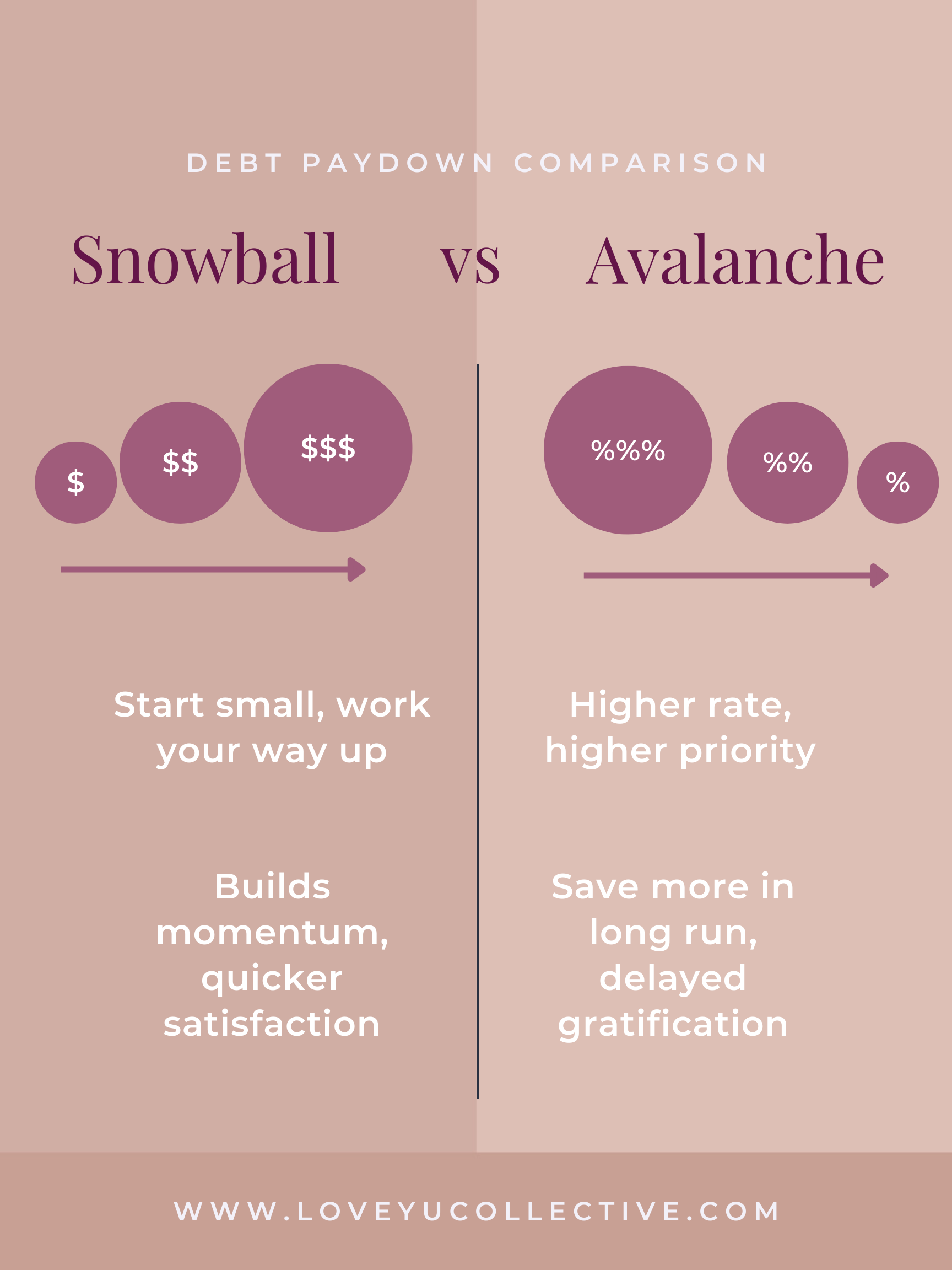
Snowball or Avalanche:
Which One Should You Choose?
Think about what is most likely to help you stay consistent.
Consider the snowball method if:
You feel overwhelmed by the number of debts you have and seeing accounts disappear would help you stay motivated.
Consider the avalanche method if:
Your priority is reducing the amount of interest you pay and you're comfortable waiting longer to completely eliminate your first account.
The mathematically optimal strategy isn't particularly useful if you abandon it after two months.
Choose an approach you understand and can realistically continue.
What If You Can't Afford More Than the Minimum Payments?
This matters because neither strategy can create money that isn't available.
If your essential expenses and minimum debt payments are already consuming your income, don't assume you've failed before you've begun.
Your first step may simply be stabilizing the situation.
If you're behind on payments, contact your creditors and ask what hardship programs, modified payment plans, or other options may be available. Depending on your circumstances, you may also want to speak with a reputable nonprofit credit counselor who can help you review your debt and possible repayment options.
Be cautious with debt-consolidation and debt-relief offers. Consolidating debt can sometimes simplify payments or reduce interest costs, but the terms, fees, interest rate, repayment period, and type of program matter. A lower monthly payment does not automatically mean you're paying less overall.
The goal is to understand what you're agreeing to before making another financial commitment.
Make Your Debt Plan Part of Your Money Routine
You don't have to think about your debt every day to make progress on it.
Create a regular time to check in with your finances, whether that's weekly, twice a month, or around payday.
Use that time to:
Review your balances
Make or schedule payments
Update your progress
Check upcoming expenses
Adjust your plan when life changes
Then give yourself permission to move on with the rest of your day.
A plan gives your money concerns somewhere to go besides your thoughts.
Your Debt Is Something You're Managing, Not a Measure of You
There are countless reasons people carry debt. Education. Healthcare. Housing. Family responsibilities. Emergencies. Starting a business. Everyday expenses during a difficult season.
Whatever brought you here, shame isn't a repayment strategy.
Information is useful. A plan is useful. Consistent action is useful.
Start with the numbers in front of you. Choose your strategy. Make the next payment you can reasonably make.
Then keep going.
Every payment doesn't have to feel monumental to matter. Progress happens one decision at a time, and creating greater control over your finances can also create something valuable beyond a lower balance: a little more room to breathe.